

Olimarao atoll is small and looks nicely surrounded by a barrier reef, so we expected a calm anchorage. Unfortunately the barrier reef is so submerged, that swell makes it in from all sides and at high water we were bouncing every day in crossed seas despite different stern line attempts to try and face the swell… We ended up sleeping in passage mode (one on the salon sofa the other one on the passage mattress on the floor) most of the time and we spent one unnerving night pounding the sandy bottom with the keel during low water (that anchorage was a teeny bit too close to shore).
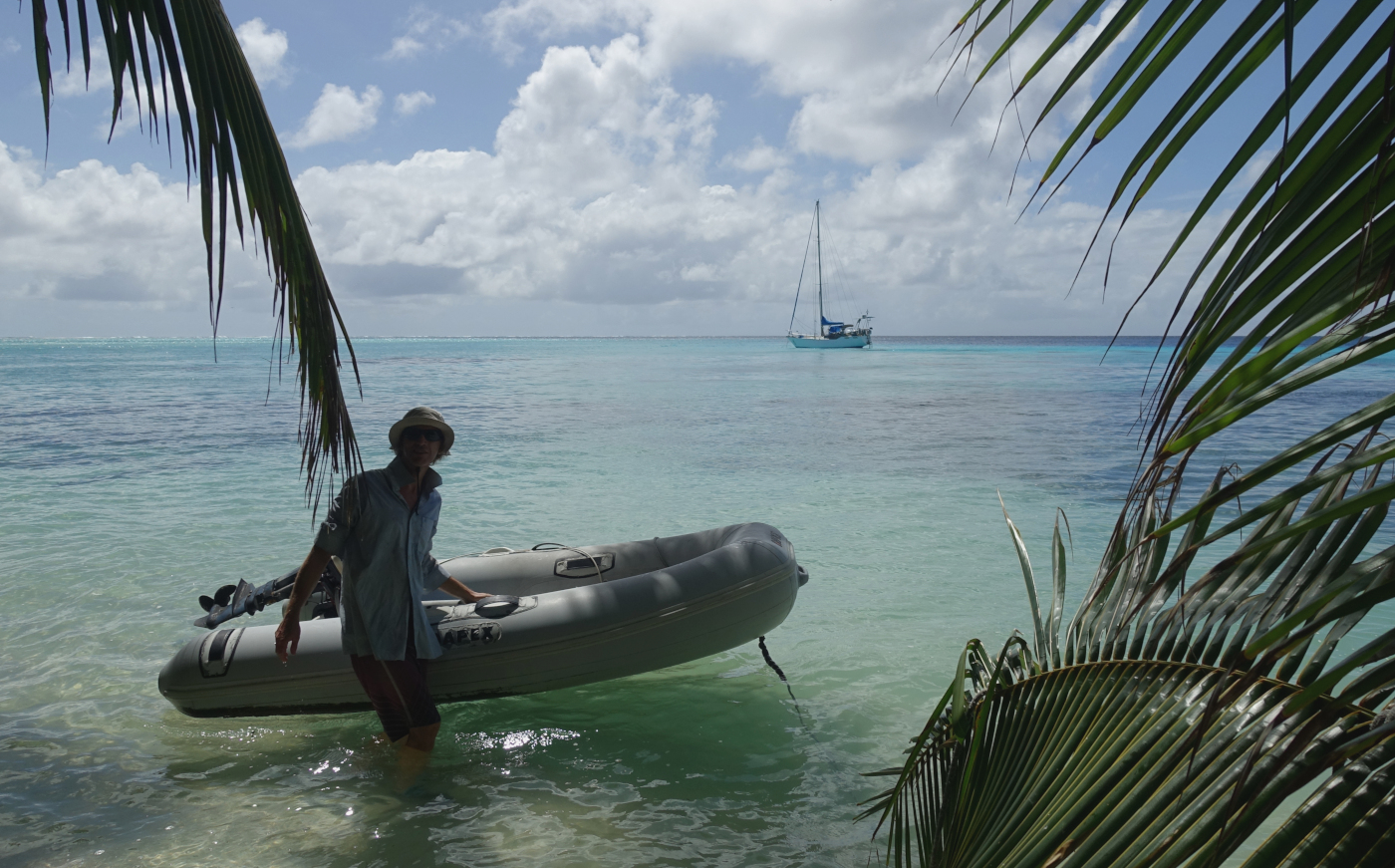
We’re now in the NE trade wind belt and so it’s blowing hard most days with accordingly high waves and swell.
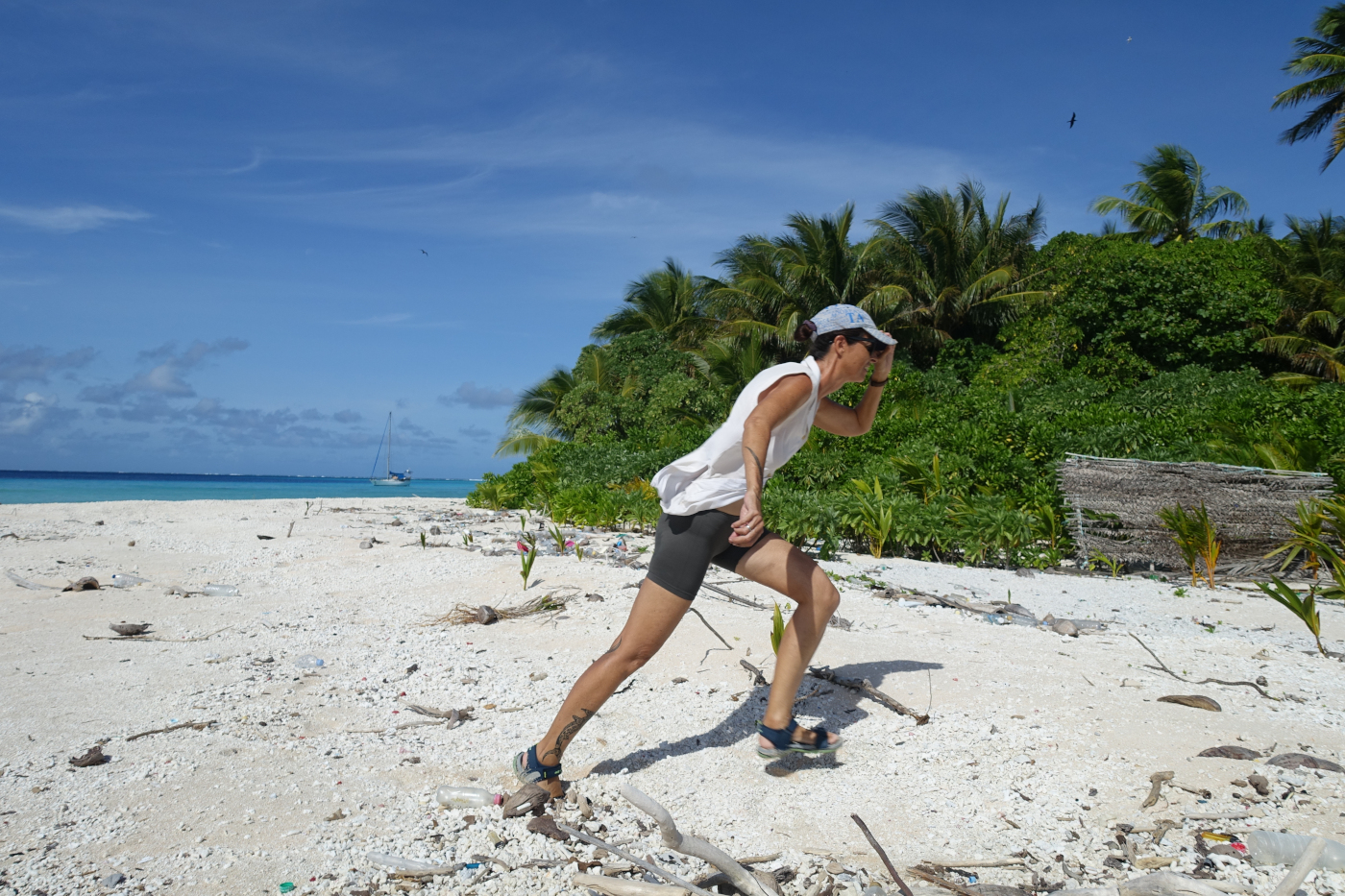
Anyway, it was worth it as we got to enjoy an incredibly lively underwater world with swarms of chubs, scads and all the predators chasing them. Olimarao is uninhabited, but people on Elato told us that they (and more often the neighbours from Lamotrek) go over to the little atoll to hunt turtles. Their raids are apparently thorough–we didn’t see a single turtle in 2 weeks (and that’s not a seasonal thing as we saw plenty in the neighbouring atolls). What’s also missing in the lagoon is sea cucumbers (so maybe a Chinese ship got in to harvest them?) and parrot fish are functionally extinct (most likely due to too much spearfishing at some point), which is a shame as the corals in the shallows are badly damaged and in need of herbivore fishy cleaners.
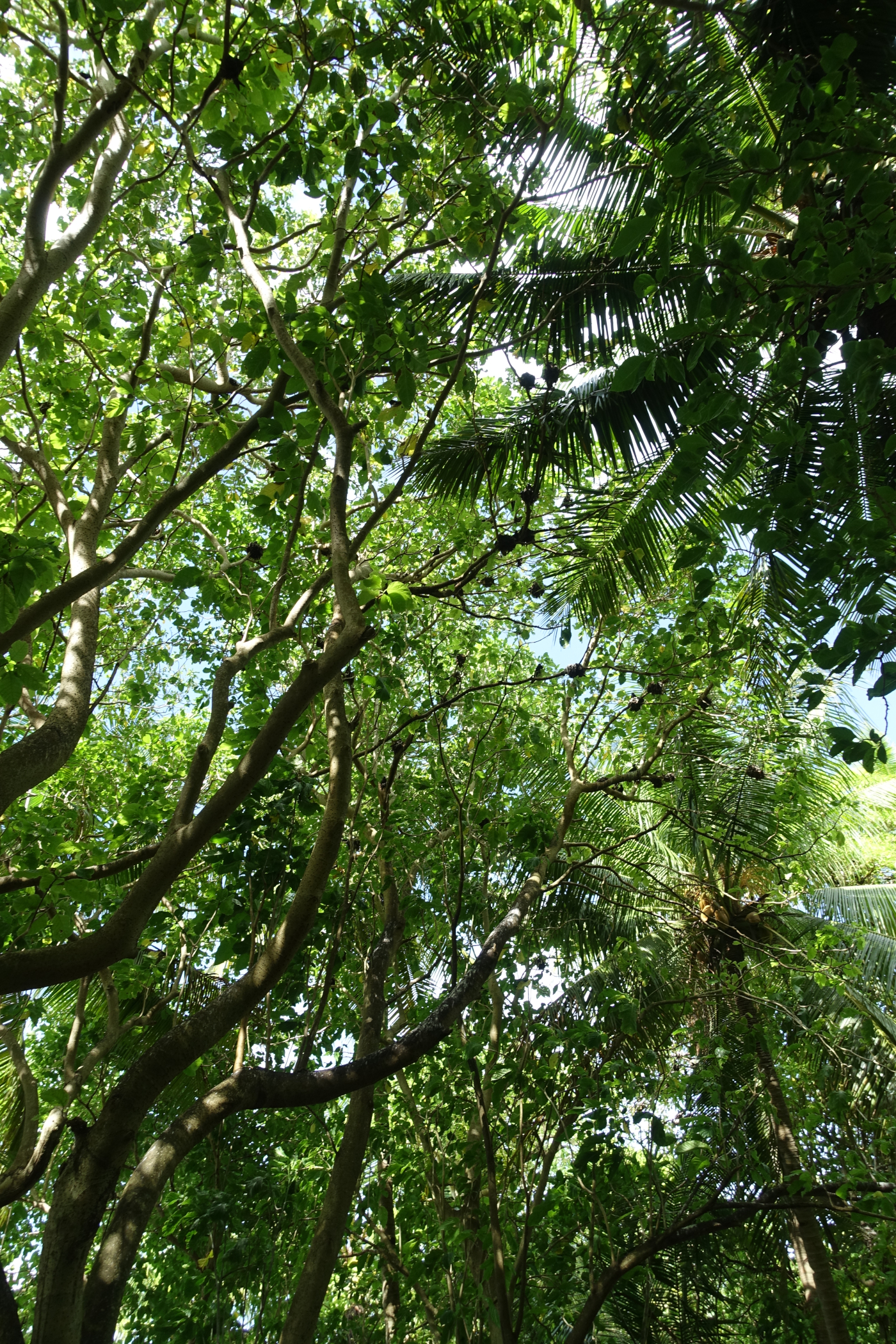
The main island with an anchorage for E and NE winds is quite pretty with not just palm trees, but also some leaf trees that provide nesting space for noddie terns.
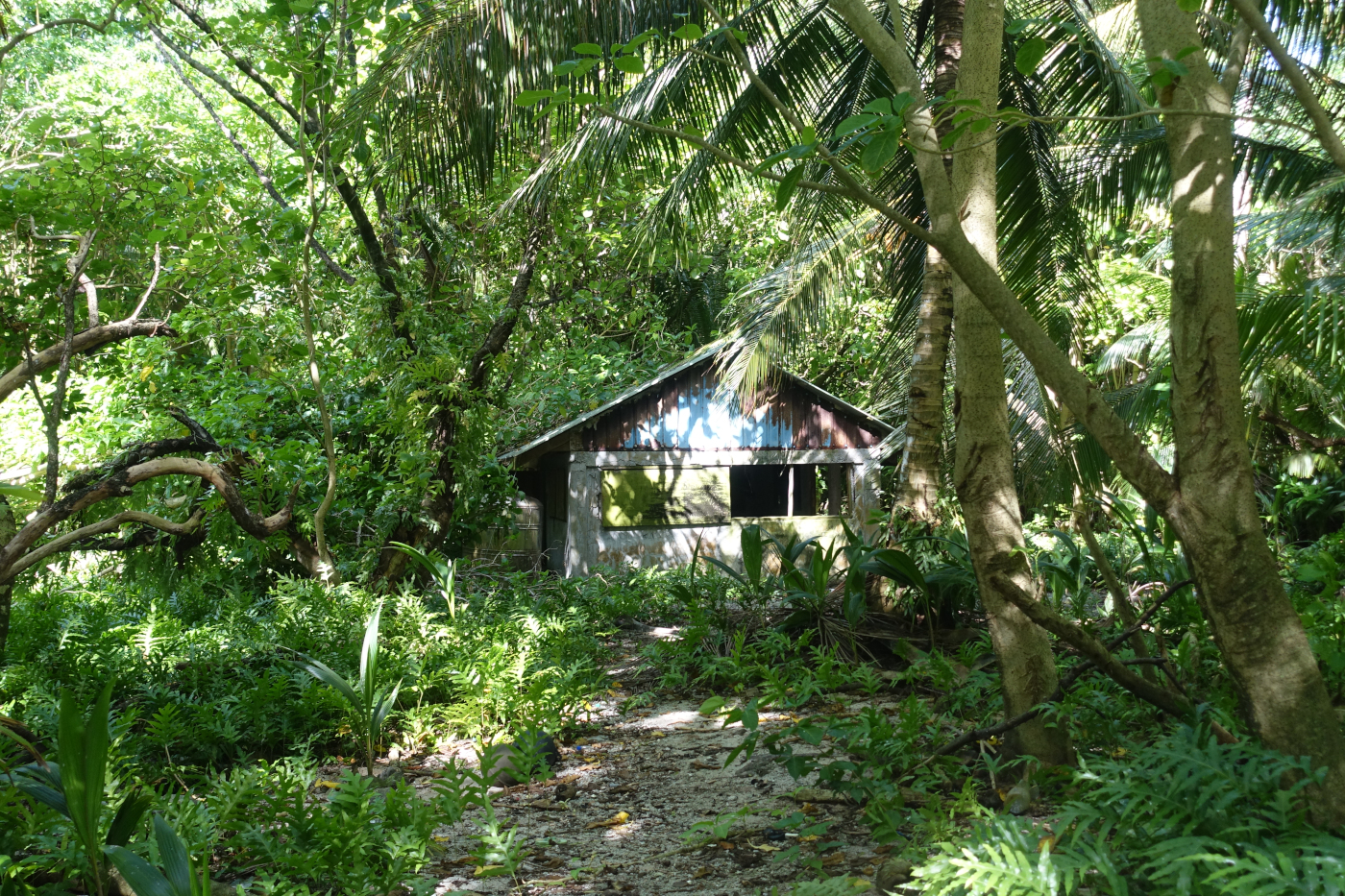
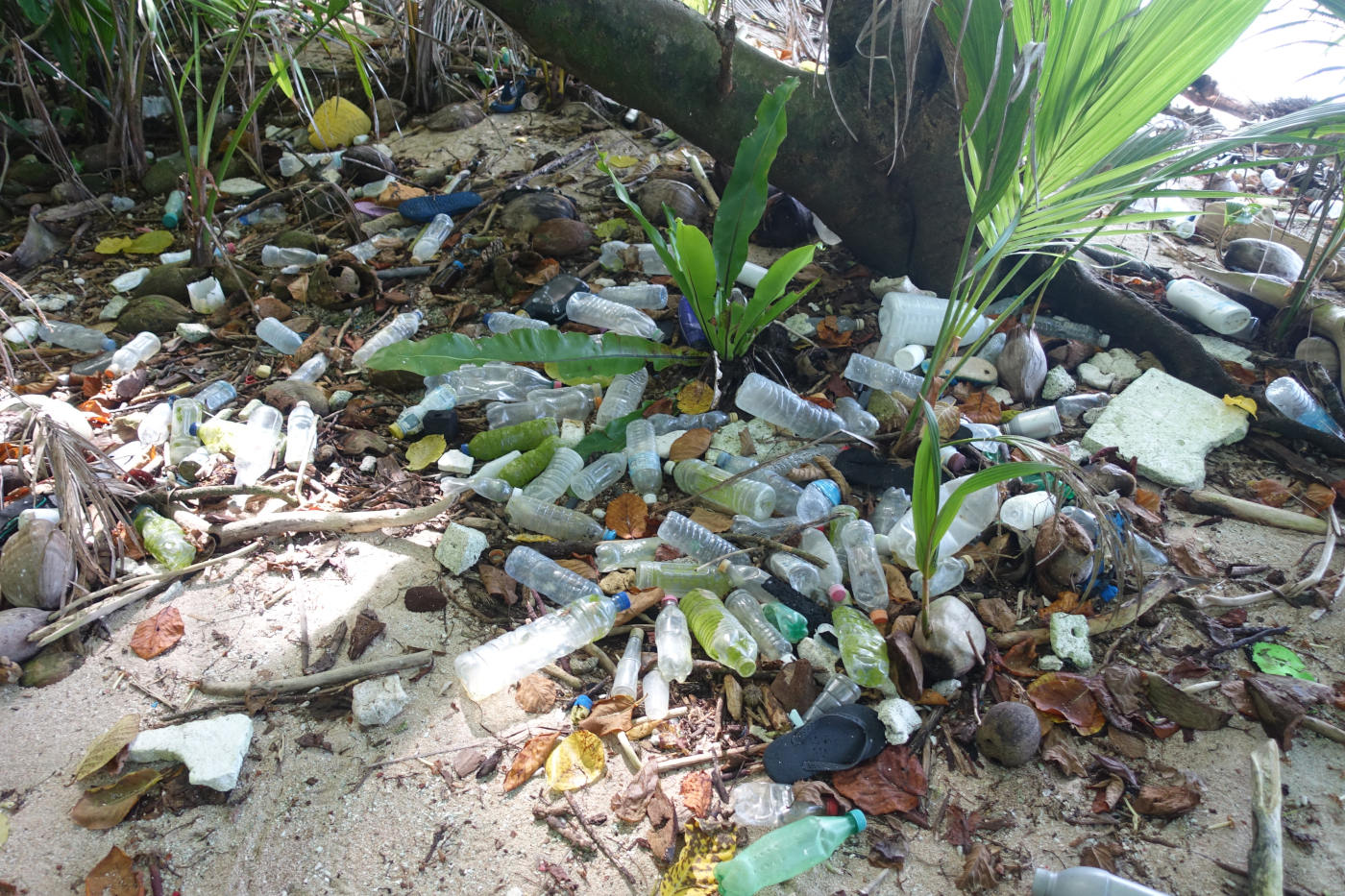
We found an abandoned church in the forest and WAY too much plastic trash all over the place that gets blown here… We burned some and hope that cruisers following in our wake will do their share to help cleaning up the island as well 
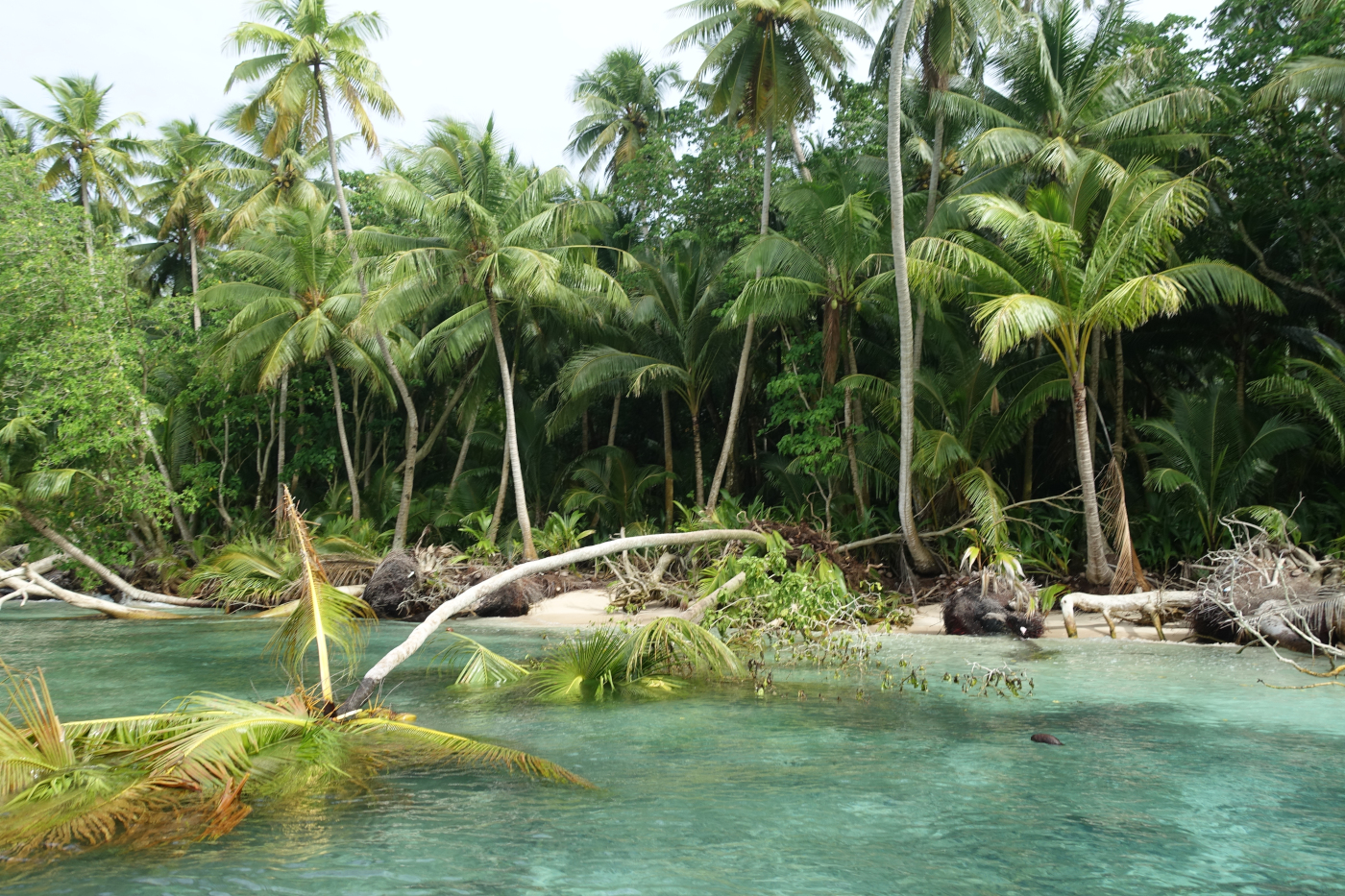
Unfortunately erosion is visibly gnawing on the shore: where older google images still show a beach off the coast the waves are now splashing up right to the trees. We found dozens of sunken trunks close to shore in the lagoon and the next line of palm trees and shrubs has already fallen over again–we witnessed several trees coming down while we were there with high tides during new moon and some southerly swell. Really sad to see rising sea levels and coastal erosion at work:


8 comments
Michael Bradley says:
January 19, 2026 at 7:19 am (UTC 0)
Climate change is so real. So sad that politicians mostly ignore it..
Cam says:
February 17, 2026 at 5:12 am (UTC 0)
I’m curious as to why you chose these words: “Their raids are apparently thorough–we didn’t see a single turtle in 2 weeks.” etc. Seems to have some incredibly negative connotations. The people of Lamotrek, Elato, and many more nearby atolls have been harvesting turtles and other marine resources for thousands of years in ways that are sustainable and incredibly culturally significant. From the perspective of someone coming from an industrialized world, these practices may look destructive, but that interpretation doesn’t reflect local stewardship (and is quite silly when you think about it). “Thorough raids” are hardly the words to describe their harvest.
***The Lamotrek community has been careful environmental stewards for generations and will continue to be. Unfortunately, that’s lost on clueless outsiders who confuse their brief, uninformed impressions with understanding – while ignoring the far greater damage done by the industrialized world they come from.***
The people of Micronesia would be able to continue these practices for thousands more years, absent the rest of the world’s bad practices (industrial fishing and external pressures). Bottom line: there is an important distinction between long-standing subsistence traditions and modern destructive impacts; flattening that distinction does real harm.
Other than that, beautiful photos and fascinating story. The plastic accumulation is truly horrifying. Since the industrial revolution, we have seen a 20-25 cm (8-10 in) sea level rise – an enormous change with serious implications on storm surges and erosion in remote atolls. These islands bear the consequences of decisions made far beyond their shores and rely on the broader, industrialized world to act with environmental responsibility.
Birgit says:
February 18, 2026 at 6:06 am (UTC 0)
Hello camghef1@gmail.com,
I find it strange that someone would write a comment anonymous, signing off without name, with an email address that looks suspicious and a webpage link that leads to an AI website. Given these circumstances we hesitated to approve the comment at first, but then I decided to publish it anyway–no matter if it was written by a real person or AI generated–as it raises some issues that are interesting to address.
You are asking why I chose the term “raid” for a hunting expedition to a neighbouring, uninhabited atoll: Well, it’s because the fact that there are almost no turtles left in what used to be known as the traditional turtle hunting grounds strongly suggests that there has been no responsible “stewardship” going on, but greedy emptying of a place to kill the last turtle before the neighbour does. Going there guided by GPS using strong outboard engines to hunt with modern spearguns has nothing to do with traditional lifestyle. Btw “Harvesting” is a euphemism that doesn’t fit killing a wild animal at all as it implies picking the cultivated fruit of a plant you sowed earlier on…
Yes, the inhabitants of little islands obviously used to traditionally take care of their resources or they would have starved to death in times before aid or supply ships. They may not have called it sustainability then, but certainly understood that if you take too much today, you won’t have enough tomorrow. But it seems like this traditional knowledge (like no-take zones or no-take periods for certain fish e.g. during their spawning season) has been lost in contact with the “modern world”. What has arrived with this contact are new gadgets: spearguns, underwater torches, outboard engines, GPS, freezers, supply ships and electricity for freezers. All of those make it easier to catch fish and turtles and also to export them to earn money, which is now necessary in order to buy all those wonderful above mentioned goods that are not traditional. While it’s sustainable to fish and hunt in order to feed a village, it’s not sustainable to export.
It’s true that big fishing fleets are responsible for emptying the oceans, so it’s harder for islanders to fish pelagic species outside the atoll, which makes them focus their fishing on reef fish and of course climate change with rising sea temperatures and acidification is harming reefs on a global level. Instead of keeping up the hunter/gatherer lifestyle and even intensify it with modern equipment, the islanders will probably have to switch to a farming lifestyle (like Europeans had to about 9000 years ago) and actively raise more animals as protein supply (like raising chickens) and to diversify their gardens with more and different vegetables (instead of solely growing taro and picking breadfruit, bananas and papaya).
We have snorkeled on atolls from Southern Micronesia up to Chuuk and westwards from there and most of the reefs are badly overfished with a serious loss in biodiversity and biomass among fish and with lots of coral damaged and/or dying. Reef fish are the ones keeping the coral healthy that in turn provides shelter and a home for fish, so one can’t exist without the other. According to our opinion and to what we have seen and experienced in other island nations across the Pacific, Micronesians now have two options:
They can continue overfishing and overhunting, run out of fish and turtles within a few years and face the end of their traditional subsistence existence and either move away or swap their diet to imported canned food. Or they can choose to act now, establish no-take zones as breeding grounds, protect key species (such as parrot fish and turtles) and continue their fishing lifestyle on a somewhat smaller scale in combination with alternative food sources. This is what we have been explaining to chiefs, elders and fishermen in combination with photo presentations on many islands. Not as patronising know-it-all tourists, but from our experience of 15 years on islands across the Pacific with plenty of good (sustainable) examples along the way and sadly lots of algae-overgrown underwater deserts that were fished empty and are past a point where saving measures could still help.
I’m fully aware that the “modern world” is not using its resources in a sustainable way, neither is it looking after the environment in a responsible way. But that doesn’t mean that little island nations should follow that role model and ruin their environment as well. I’m sure that the majority of the trash that is washed up on the shores here is coming from some mainland, but tons of it are also dumped in Chuuk and on several small islands that we visited all rubbish (including plastic) is still thrown into the ocean. While it’s good to see that some little islands are straining to preserve their traditional life, they have to make adjustments to deal with changed circumstances and new challenges and problems.
Cam says:
February 18, 2026 at 10:36 pm (UTC 0)
As far as my website goes, I just put my email address in as my website (what AI website did it bring you to?). Idk what happened hahaha sorry, I don’t blog very much! I’m also sorry this response is so long, but I truly hope you read all of it. There are some really cool studies on all of this that I have cited.
Thank you for taking the time to respond thoroughly, and I can understand where you’re coming from; we agree on a lot more than is obvious. However, there are a few really important distinctions that I would like to point out.
Firstly, defining a quick parameter, my reply was referring to remote outer-island atolls. Not the main concentrations such as Yap Proper, Pohnpei, Kosrae, and Chuuk. I make that distinction because in these established states, export really matters, right? They have export markets, economies, and frequent shipping that fundamentally change incentives – likely causing exploitation of the land.
If we want to resort to nitpicking my language, here is the Merriam-Webster (second) definition of harvest: “to gather, catch, hunt, or kill (salmon, oysters, deer, etc.) for human use, sport, or population control.” It is standard terminology in fisheries and wildlife management. It does not always mean picking a cultivated fruit; if that is what it implies to you, that is not my concern.
Moving on, regional green turtle populations in Micronesia have been stabilizing or recovering in several surveys over recent years and decades (albeit they ARE low). This is largely because of nesting beach protection and legislation on international trade. These are shown by IUCN in 2021, NOAA NMFS in 2020, and even a Pritchard paper from the 70’s. Who have these changes affected? Not so much the outer islands because they really don’t show significant export. Interpretation of these numbers really attributes positive change to legislation placed on the larger states of Yap, Chuuk, etc… Exportation of turtle is not legal by CITES – it is not the problem; but I will cede that this is not true for inter-island trade! In my opinion, the existence of shared hunting grounds between two atolls points to bounded access, not indiscriminate, careless harvest. Stability of the population is likely because of the way Lamotrek manages Olimarao, not in spite of it.
I would also like to note that outer-island populations are declining, not growing. We are talking about atolls that have lost 30-60% of their population since the mid-20th century. Emigration has absolutely put a strain on the population (These numbers can be found through the FSM office and by Hezel in 2013). And we are talking about people that is innately resourceful and removed enough from modern society that they caution against waste. Supply ships are infrequent, export is minimal as there is no infrastructure, and most harvest remains local rather than commercial.
Quick aside, farming in Europe was significantly influenced by an increase in population, which isn’t the main driver here. Switching to farming-intensive monoculture, like Europe, would likely have serious consequences: the calcareous, infertile soil of these Micronesian atolls would rely heavily on importing fertilizer. This would cause nutrient-rich runoff, harmful blooms, increased toxicity, and ultimately the destruction of these ecosystems through eutrophication and oxygen depletion. TL/DR, it would suck if they switched to European monoculture-style farming.
On fish and reefs, I will also cede that reef degradation and loss of herbivores are detrimental. However, I think another thing we can agree on is that this is correlated with and influenced by external forces. Overharvest of reef fish in these atolls can’t be excused, but it can be explained.
I love your outlook on this, right? Rather than abandoning fisheries entirely, locally led management should be brought in. Disturbance is, to an extent, healthy for an environment and benefits early successional species. Goven et al. found in 2019 that the strongest outcomes have come from locally led management (species protection, seasonal closures, etc) rather than abandonment of fisheries.
Note on the algae-covered coral deserts, I just read a really interesting paper on those, and I’d love to read more about that! I’m NOT saying that this isn’t due to a lack of herbivores, but I wouldn’t be surprised if it were largely affected by global change. You see, as coral bleaching occurs, their symbionts, called zooxanthellae, are ejected. After a while, the coral dies. Then, interestingly, the coral becomes a nutrient-rich substrate for turfing algae that can oftentimes grow faster than consumers can remove it. Then the coral can’t return to its healthy state! Also, AS CORAL DIES, FISH ABANDON IT (caps to draw the eye, I’m saying it calmly in my head haahaha). So, it would track that as 50% of the world’s coral has been lost since 1950 (due to OA and increasing ocean temps), we are going to see more coral barrens without fish. Again, this helps to explain, but doesn’t excuse.
Thanks for your response! Your adventures look incredible!
Birgit Hackl says:
February 20, 2026 at 4:01 am (UTC 0)
Hi,
it would still be nice to know your name and even more importantly your background for our little discussion here.
Concerning “export”: I was also referring to outer islands, but with “exporting” I didn’t mean sending fish abroad, but simply to larger islands (like Yap, Ponape or Chuuk) to be sold on the market (merriam webster: export, to carry or send (something, such as a commodity) to some other place (such as another country)). Exporting salted/smoked reef fish is not sustainable and the situation gets extreme as soon as large freezers are available to accumulate fish until the next supply ship comes.
I have written articles about sustainable fishing and have therefore done quite some research about studies, but they are too few and too far apart (both in time and space) to really give an impression of what’s going on underneath the surface of the Pacific (that always looks nice and blue even though its underwater landscapes are getting empty).
We on the other hand, have a long-term, extensive survey going on. In 15 years of cruising the Pacific all-year-round, we have visited quite a few places. I’ve just counted on the chart (quickly, so I might have missed a few):
Micronesia 9 islands/atolls
PNG 13
Solomons 18
Vanuatu 10
Fiji 43
Tonga 2
Niue 2
Cook Islands 5
Fr Poly:
Australs 5
Gambier archipelago
Tuamotu 20
Marquesas 6
Societies 15
Galapagos 1
I count atolls and small archipelagos as “1″ even though they often comprise of 10 islands and islets or more, so I can guesstimate that we have anchored off 1500 islets/islands. When there are reefs around, we usually spend about an hour in the water daily, not splashing around like tourists, but checking bio-diversity and biomass.
What we have experienced is that by now you only find large numbers (and variety) of fish around places that are so extremely remote that no or only rare local hunters get there (like Caroline (Line Islands) or Roncador Reef (Solomons)) and in Marine Protected Areas. Interestingly enough, those uninhabited places that can be reached from neighbouring islands/atolls are worst off as everyone seems to treat them like a free buffet (e.g. Yaqasa, Fiji, where the reef is not only empty, but devastated by practices like dynamite fishing and hunting with bleach).
With turtles the situation is even more extreme and obvious: Basically in all areas where locals still hunt turtles, we met maybe 1 or 2 specimen over the course of 2 weeks, while it’s normal to encounter about 5 turtles per snorkel in areas far away from civilisation (e.g. Maria, Austral Islands or Caroline, Line Islands) or in areas where locals are discouraged with hefty fines (e.g. Aitutaki, Cook Islands) or in regions where lots of awareness-raising and a dependency on tourism has led to protection (e.g. Moorea, Fr Poly). One interesting example is the St. Matthias group in PNG, where diet restrictions due to religion (all islanders are 7th day adventists) lead to high numbers of turtles, rays, sharks and clams around the islands…
So while global problems like turtles ending up as by-catch in fishing nets, dying from ingesting plastic or losing habitat/nesting grounds may lead to globally lower numbers in general, local practices make a huge difference in numbers from island to island.
In Olimarao we saw 1(!) little turtle during the 2 weeks we spent there, which–at least to me–is a clear sign that there is no responsible stewardship going on to sustain numbers on the same level.
On top of observing, we talk to people and especially fishermen about their impression of reef health, whenever there’s a village nearby. While some claim to still have “plenty” in spite of obviously empty reefs (we don’t argue then, it’s not worth it), most admit declining numbers of fish, turtles and birds (if there are any left at all) and many ask for advice on how to deal with the changing situation. In such cases we are happy to share our experiences and gathered knowledge, e.g. of success stories like Rapa Iti, where the islanders decided to turn the whole eastern side of their island into a rahui, a no-take-zone, in the 1980s and profit from sustainable fishing from the overflow ever since.
Concerning gardening on atolls: Yes, I know that the population of outer islands here is shrinking, but it seems that they still can’t meet their needs for a balanced, healthy diet under changing conditions without depending on (unreliable) supply ships. Of course I didn’t mean that islanders should start intensive monocultures, that would be absurd. But with initiatives to promote composting and use of organic fertisliser (eg. made from fish guts), islanders can grow lots of different produce on coral atolls (e.g. like in Tikehau, Fr. Poly). They are just hesitant to make an effort as it’s not part of their traditional life-style, but then hey, facebook and youtube aren’t so traditional either and still popular.
Btw it’s a common misconception that coral atolls are barren places. In their natural state with a variety of deciduous trees and shrubs that shed leaves and bird colonies to fertilise this soil with their droppings (guano) they are rich and fertile. Unfortunately there aren’t many examples of such natural motu left, as most were burned down for coconut tree monoculture for the copra industry, which left them as the barren heaps of coconut rubble most people perceive as normal now.
Concerning coral health, bleaching, resilient cora and spawn/recruits, I’ve written articles about that as well a couple of years ago and have gathered quite some interesting sources back then. Coming from an academic background, I don’t just make claims, but make sure to check my facts. I have listed a few of those sources below, if you’re interested.
Best regards,
Birgit
Science magazine: Coral and baby fish smell their way to the best homehttps://www.science.org/content/article/baby-corals-and-fish-smell-their-way-best-home
Smithsonian Magazine: How an Ancient Practice Aids Marine Conservation, Tiare Tuuhia, Hakai
https://www.smithsonianmag.com/science-nature/rahui-and-the-art-of-marine-conservation-180983179/
ABC News: Fiji’s beaches and reefs face an uncertain future but this scientist says ‘assisted evolution’ can keep them alive
By Fiji reporter Lice Movono and ABC Pacific’s Nick Sas in Tagaqe, Fiji
Posted Sun 2 Jul 2023
https://www.abc.net.au/news/2023-07-02/assisted-evolution-to-keep-fiji-reefs-alive/102507974
Georgia Tech News
Marine protected areas might not be enough to help overfished reefs recover
Mark Hay, Danielle Dixson. Research sponsored by the National Science Foundation (NSF), the National Institutes of Health (NIH), and the Teasley Endowment to Georgia Tech.
https://news.gatech.edu/news/2014/08/21/marine-protected-areas-might-not-be-enough-help-overfished-reefs-recover
Elodie Fache, Simonne Pauwels. ”Tackling coastal ‘overfishing’ in Fiji: Advocating for indigenous
worldview, knowledge and values to be the backbone of fisheries management strategies”. Maritime
Studies, 2020, 19 (1), pp.41-52.
https://hal.science/hal-02194415/file/Fache%20and%20Pauwels_2020%20Maritime%20Studies_PREPRINT.pdf
Conservation Science and Practiace Journal
Spawning potential surveys in Fiji: A new song of change for small-scale fisheries in the Pacific
Jeremy Prince, Watisoni Lalavanua, Jone Tamanitoakula, Laitia Tamata, Stuart Green, Scott Radway, Epeli Loganimoce, Tevita Vodivodi, Kalisiana Marama, Pitila Waqainabete
https://conbio.onlinelibrary.wiley.com/doi/full/10.1111/csp2.273
Fiji Barrier Reef marine ecoregion
WWF International Corals Initiative
https://wwfeu.awsassets.panda.org/downloads/wwffiji2.pdf
WWF
Spawning potential surveys in Fiji: A new song of change for small-scale fisheries in the Pacific
Jeremy Prince, Watisoni Lalavanua, Jone Tamanitoakula, Laitia Tamata, Stuart Green, Scott Radway, Epeli Loganimoce, Tevita Vodivodi, Kalisiana Marama, Pitila Waqainabete … See all authors
First published: 18 September 2020
https://conbio.onlinelibrary.wiley.com/doi/full/10.1111/csp2.273
Cam says:
February 20, 2026 at 10:40 pm (UTC 0)
Yeah, my name is Cameron, and I am currently a marine ecologist and evolutionary biologist. My major and most applicable background here is that I research vulnerable marine habitats in the Anthropocene (emphasizing comparative morphology and behavioral ecology).
I genuinely respect the depth of your experience – fifteen years of observation across so many islands gives a range that most people dream of. At the same time, my comments on the outer islands of Yap are just that – on the outer islands of Yap. However, I would love to know more about your sample of the Pacific! I am wondering if y’all have ever experimented with transect or fixed quadrat sampling to collect quantitative data in your adventures? Especially in these islands where there’s so little research being done, that would be a cool read!
So concerning export: Lamotrek does not export salted fish to Yap Proper, Pohnpei, or Chuuk, as there is no commercial shipping for artisanal fish, and there is no need to. Lamotrek (while making marginal amounts of money from copra, government employment, and remittances) has a mostly self-sufficient, subsistence-based economy – they don’t have a GDP, they don’t have an incentive. The fish and marine resources from Lamotrek are managed through subsistence and tribute systems. However, Chuuk has been known to export fish abroad to Guam, Hawai’i, etc. That goes back to my argument that legislation is more effectively and more often placed on the major economies of the FSM rather than the outer islands in the face of anthropogenic change. Criticize longline/gillnet/trawler fishing and global carbon emissions that have decimated 50% of our worlds coral. But again, I would say we are in agreement regarding tropical fish, as it has gotten to a point where every fish counts. (Thanks for the stories! They sound incredible, and I have read through some of the sources – very interesting).
Regarding the main point of contention, turtles, and Lamotrek, Elato, and Olimarao: I understand that you only saw one turtle there; however, a lack of stewardship by Lamotrek is not an empirically sound conclusion. It is a traditional hunting ground (more on this is following) because it is uninhabited. This way, they can attempt to preserve the ecology of their home lagoon (though I don’t know how successful that is). 2 weeks and a comparison to 5 turtles usually seen is not statistically admissible in a dynamic and seasonal sacred hunting ground. Also, as I said before, the islands bear the consequences of decisions made far beyond their shores.
My point has been that I don’t think that villainizing a community who have been doing this for THOUSANDS of years, even based on 15 years of experience, is kind or fair. Absent the rest of the world’s pressures, imagine what the turtle and fish population on Olimarao would look like – not to mention the reef! That is stewardship. (also declining populations mean declining demand, maybe their take will gradually decrease?)
The idea that Lamotrek and Elato are racing to “kill the last turtle before the neighbour does,” as you say, simply isn’t the case. Here’s Why: You seem to be projecting a Western “Tragedy of the Commons” principle to the situation, and you are stating that there is NO responsible stewardship. However, these atolls operate with canonical, both legal and legislative, regulations:
1) The Yap State Environmental Protection Agency Regulation No. 2014-05: This highlights that there are de facto regulations regarding the take of marine testudines. Such include “Wholly Protected Sea Turtles” (Leatherback, Hawksbill), no-take seasons (Eggs, flesh, etc., from Mar-Aug – and I believe Dec-Jan, but that is a different source), minimum carapace length (Green: 40 inches, Olive Ridley: 25 inches). Some of the things that you recommend for the area exist today.
2) Turtle harvesting practices in Lamotrek are based on a “ke” (fish hook) system: Lamotrek is the dominant island in the triad consisting of itself, Elato, and Satawal. With this, turtles harvested must be approved by the Chief of Lamotrek (there are caveats regarding Satawal, but I won’t write an essay about that) and the legislation stated above. They are communal; there is no race to kill the last turtle; it is collected and distributed as chiefly property. One island’s greed could result in a diplomatic crisis in a system based on shared rights. There are also severe consequences for greed (breaking a harvest taboo).
Given that information, as well as regional data showing recovery of turtle populations in Micronesia (despite global pressure), wouldn’t you say that there is, in fact, local stewardship? Doesn’t this suggest that the effects of their hunt aren’t significantly radiating into the entire region?
Moreso, I happen to know that Lamotrek just had a successful visit to Olimarao and took 4 turtles (standard “bag limit,” as it were; a number that foresight has gone into). This is a fair comparison to your stated ~5 turtle standard. Regardless, you seem to think that stewardship is not on the agenda for these peoples. But traditionally, sustainability isn’t/wasn’t just because they “…won’t have food tomorrow” (as you theorized earlier). The traditional respect for the ocean and the spiritual and sacred connections to her resources is incontestable. They aren’t just protein; they are a relationship with the sea. Common sense is not a reasonable substitute for stewardship; if it were, we wouldn’t be experiencing the crises present today. Honestly, it’s a little surprising that you make these claims and then cite papers advocating for building on indigenous ontology and involving their religious leaders in conservation efforts.
I would also like to say that I am well aware that coral atolls aren’t barren (I find them incredibly interesting from an evolutionary standpoint for exactly this reason). However, the flora have evolved highly specific traits to thrive on them: Being halophytic to protect them from inundation and spray, succulence to conserve water in the highly porous calcareous soil, wind resistance for the low-lying geography, soil building by early successional species, and buoyant seeds to travel vast distances. Farming would be difficult, but it is, like you said, doable. However, in my opinion, it is important for them to continue their traditional practices.
Tradition is a weird thing, though, isn’t it? You mention Facebook and YouTube not being traditional, but still being utilized. GPS isn’t traditional for sailors. Neither are modern luxuries, nor are a plethora of other things that we all use nowadays, but are sailors nonetheless. According to their culture, these food sources are a necessity. Further, food security is fragile on Lamotrek, and their right to hunt in this way allows the people to maintain their identity as self-sufficient people rather than being dependent on external aid. Tradition is not independent of augmentation. Change is inevitable, sovereignty is fragile, but both can exist.
With respect and appreciation for the dialogue,
Cameron
Birgit says:
February 22, 2026 at 12:50 am (UTC 0)
Hi Cameron,
we have often tried to contact local organisations to share pics/data, but they weren’t really interested as they seem to prefer to go on expeditions themselves. Our friends have started a great project though to share video transects with scientists: https://planet-ocean.org/en/csi-coral.html
We’re certainly not against traditional conservation methods, in fact we’ve been trying to persuade communities all over the Pacific to return to such traditions (e.g. the tabu zone we initiated in Matuku, Fiji). It sounds like the traditional communities in Micronesia do have such a set of rules to ensure sustainable use (and you’re not the first one to tell us about them, we’ve also heard details e.g.from chief Manu in Ifalik and the principal of the college in Woleai), but looking at the empty reefs and the low number of turtles, it seems that these no-take rules (temporary, locally, on species, on fishing methods) are either not enough to ensure stable numbers in the current situation, or they are not respected (as we saw e.g. in Woleai where we observed plenty of unterwater lights at night despite the fact that nighttime spearfishing is discouraged…).
Let me clarify our observations on turtle numbers: it’s not 5 turtles versus 1 turtle spotted in 2 weeks in a certain area as you interpreted my text. The comparison is 5 turtles in 1 hour(!) of snorkeling in areas without hunting versus 1 turtle spotted in 2 weeks(!) of daily snorkeling in areas where they are hunted. I think those numbers speak for themselves. My aim is not to “villainise” a community, I simply state that their methods of conservation are not effective.
Whenever we discuss turtles with local communities I explain that global numbers are lower due to commercial fishing, pollution and loss of habitat and that if they want their children and grandchildren still be able to watch turtles coming into the lagoon for nesting, they have to become proud of “their” turtles and protect them. Not for tourists, not for the government, not for some NGO and certainly not for us, but for their children and grandchildren.
Cam says:
February 18, 2026 at 11:03 pm (UTC 0)
I’d also like to add that you make great points about the modernization of these traditional practices. But I think it would be a shame if they had to stop something that has sustained them for so long because of the rest of the world. Let’s not forget that it isn’t necessarily a regional issue, as the whole world is experiencing the marine testudine crisis. What if the FSM establishes a quota like the 5-whale quota implemented on the Makah people? I really don’t think it’s an evil practice that deserves such reprimand.