
We have 5 lemon trees full of big, juicy fruits in our garden, a mango tree with loaded branches and two papaya trees that we can harvest from every day. Leaving the fruities to rot under the trees doesn’t feel right, so we do our best to make use of them. Today we made 3 litres of papaya-mango sorbet (we have a gigantic freezer in the house) and then Christian spent the afternoon squeezing lemons and we made 2 litres of lemon sirup (with a kilo of sugar
)
2017
13
Jan
Fruity days
2017
08
Jan
A house on Taravai
In Tahanea one of our two water tanks started leaking, so we’ve only been using the other one since October. As we have a watermaker that’s no big deal, but we should still repair it at some point. We’ll have to cut away part of the wood underneath the sofa, cut open the aluminium tank, sand the corrosion craters (one of the previous owners must have used some silver-containing water treatment), and filler the craters with plenty of epoxy. A loud, dirty, smelly and toxic job…
When we heard that the house on the southern side of Taravai needed someone to take care of it and the garden as the owners are in Tahiti, we immediately volunteered. First we have to invest of course some working days into the garden, but as soon as we start the job on the tank on Pitufa we’ll have a place to sleep away from the building site and we can harvest lots of bananas, plantains, papayas, avocados, lemons, pumpkins, breadfruit and even tomatoes, lettuce and bok choy
2017
07
Jan
Kerosene stove
It seems that always when things are just a little bit too perfect, something annoying has to happen. These nuisances usually involve either the engine, the fridge, the watermaker or the kerosene stove–the big 4 that worry us in remote places where there’s no professional help available in case of a problem.
This time it was Bertie’s turn (that’s the name of our malevolent kerosene stove) to quit on us. Yesterday we had a cold dinner and this morning Christian opened up the stove and started searching for Bertie’s ailment. It turned out that several problems had come up at the same time. One burner was blown with several holes in it, but the other two burners were clogged up. We used an airpump to get rid of the clogging (or rather constipation…), installed a new burner, Bertie is happy again and so are we.. Kerosene stoves are oldfashioned and most yachts nowadays use gas stoves instead, but we like the fact that our stove is very efficient. It uses only 2 litres of kerosene a month (even though we bake bread every second day), so the 40 litres we carry in jerry cans last a very long time. At least the climate in the Gambier is so pleasant that such an annoying job (dirty, hard to reach) doesn’t involve too much sweating.
2017
05
Jan
Picture perfect 360 degrees around
Usually life in the Gambier is very quiet, but the past two weeks have been quite eventful. We had a wonderful potluck/BBQ on christmas day with our Polynesian friends on Taravai and got to know 4 other cruising boats who spend the cyclone season here (11 in total). In Rikitea the community set up a party shed on the 30th and there were snacks and music for 3 days (the people usually didn’t arrive beore 1 in the morning, but then the party continued without a break the next morning…). On the first of January we motored back to Taravai (hectically cooking under way) for another lovely BBQ at lunch time.
Yesterday we had breakfast with the view of the pine-forested mountains of Taravai, then we lifted the anchor and only 10 miles further we anchored in front of the kitchy beautiful motu Kouaku, which is just a strip of fine white sand, shrubs on top and lots of nesting birds. This diversity in such a small archipelago makes the Gambier so special for us…
This morning there was almost no wind, the lagoon was mirror-like calm and we had coffee on deck looking out on the incredible panorama all around us: the white sand of the motu gleaming behind us, the turquoise lagoon dotted with large, colourful reefs, the rugged peaks of of the little rock islands Kamaka, Manui and Makaroa in the west, the silhouettes of the mountainous islands of Akamaru, Aukena and Mangareva in the NW and the chain of motus stretching out northwards along the barrier reef–it’s just mindboggingly beautiful here
2016
31
Dec
2016 — A year of passage making
2016 has been a year with plenty of passage making. Much more than originally planned. Starting from the Marquesas where we spent the last cyclone season we sailed westwards via Tahiti and Niue to Tonga. Unlike the majority of the cruising boats crossing the Pacific we did not sail on to Fiji, New Zealand or Australia, but decided to sail back to French Polynesia against the prevailing trade winds.
It was an interesting year with many new places and people. Sailing in the wrong direction turned out to be easier than expected, but we still sailed way too many miles (more than 5,500 nm) for our taste and life style. Only during our first year after leaving Croatia when we were in a hurry to reach the South Seas did we sail more miles (over 6,700 nm). We are happy to be back in the Gambier islands where we started our South Pacific adventure in May 2013.
1220 nm Marquesas, Kauehi, Tahiti, Raiatea, Maupihaa
1290 nm Maupihaa to Beveridge, Niue, Tongatapu
——-
2510 nm sailed westward in 20 days
1850 nm Tongatapu to Niue, Beveridge, Palmerston, Rarotonga, Tahiti
1145 nm Tahiti to Fakarava, Tahanea, Hao, Amanu, Gambier
——-
2995 nm sailed eastward in 28 1/2 days
=======
5505 nm sailed in 2016 (without miles sailed inside lagoons), 48 1/2 days on passage
2016
27
Dec
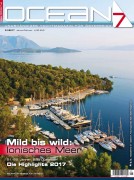
New article in Ocean7 magazine

Birgit Hackl, Christian Feldbauer: Ausrüstung auf einer Fahrtenyacht — Was hunzt, was funzt?, OCEAN7 01 (Jan./Feb.) 2017, p. 44–49.
2016
25
Dec
Happy Holidays!
Dear readers and virtual travellers,
we wish you all a merry Christmas and a healthy, happy, interesting new year! We hope you’ll keep on travelling along with us on our blog in 2017
2016
23
Dec
Midnight arrival
Yesterday we had a day with light winds, did hours of sailing, some motorsailing and a few of motoring. We caught a (smallish) yellow-fin tuna, then a torrential rainfall washed down the boat and we finished the usual post-passage cleaning already during the last hours of the trip.
We arrived at 11 pm at the pass and proceeded straight to our favourite bay Onemea. It’s not far from the pass, but there was no moon and the only means of keeping the course in the starlight was to have one eye on the GPS track and the other on the black silhouette of Taravai’s mountainous silhouette–kind of creepy, even though we’ve done the route between the reefs dozens of time in daylight. We celebrated ‘coming home’ with midnight tapas and a few drinks too many… Today it’s pouring down again and we’ve already scrubbed the deck and are now filling up every container we can find on the boat.
2016
23
Dec
Cyclone season in the Gambier Islands
We have returned to the Gambier islands for the fourth time, where we’ll spend the cyclone season 16/17. It’s good to be back in our favourite archipelago after this eventful year.
2016
21
Dec
Becalmed
Last evening the wind died on us and left us motoring for most of the night. There were a few huffs and puffs between the heavy rain clouds that had us hopefully turn off the engine a few times, but they only lasted for half an hour or so. This morning started grey, again with just a light breeze, but the weather forecast promises some more wind from the NW for today, so we hope for a breeze to take us down the last miles to the Gambier.
Despite the grey skies the ocean has this special dark-blue almost purple colour that I’ve only seen in this area (maybe it’s something typical for the higher latitudes, but we haven’t been further down than 23 degrees…) and the air is fresh and cool. I can’t wait to get back to the Gambier Islands, I feel like I can already smell the pine scent of the islands, but it’s still 70 nm to go
2016
20
Dec
On course
The weather forecast was changing daily while we were planning this trip, but so far it seems that we’ve picked a good window. We’re sailing fast and we’re almost on a direct course to the Gambier. Today the sky has turned grey and for tomorrow a wind shift from the NE to the NW is predicted–we’ll see whether it brings squally weather.
2016
19
Dec
As usual…
After a comfy start we are now heeling and bouncing over the waves–just as usual. 345 miles to go.
2016
18
Dec
Sailing to the Gambier
This afternoon we left Amanu and we’re not on the way to the Gambier, where we plan to spend the cyclone season. We have light winds and are sailing along slowly, but comfortably.
2016
18
Dec
Pretty Amanu
Amanu is a medium sized atoll with a small village (200 people according to the mayor). It is insofar special, as a wide reef just south of the village forms a nice anchorage that is protected in all directions except from the S and SE.
Yesterday we visited the cute little village (with a not so cute rubbish dump nearby from where plastic is blown all across the island) and took a look at the pass at its wildest. It looked like something you might want to attempt in a kayak if you’re into whitewater rafting, but certainly not with a sailboat.
We asked some boys who were hanging out nearby and they claimed that slack water would be an hour later. We came back in wetsuits an hour later and really, the pass was smooth, so we snorkeled both sides and marveled at huge schools of unicorn fish and some sharks.
2016
14
Dec
From Hao to Amanu
We spent a week in Hao, first anchored outside the dock, later we moved into the harbour and joined our friends on Ednbal and Raynad who were already alongside there. Apart from daily sundowners on the dock with our neighbours and free (!) internet provided by the mayor’s office Hao doesn’t have too many attractions. The ladies at the ‘mairie’ who I asked about anything to see or do, could also come up with nothing (apart from church on Sunday
). Over the past few days several planes a day landed to take school pupils from the big college in Hao back to their homes on the different atolls for Christmas.
Today we enjoyed a lovely daysail from Hao up to Amanu. The wind was steady 12-15 kn from the ESE, the seas were calm (not even the cat got seasick), and the sky mostly sunny. Hao flushed us out through its pass with 3.5-4 kn in spite of a rising tide well after low water. We reached Amanu’s pass 16 nm and 3 hours later where a strong ingoing current and opposing wind caused steep waves inside the pass. Amanu has a narrow pass with a reef that requires a turn at the end, so we waited an hour, sailed further up and down hoping to eventually catch a fish, but no luck there. An hour later we had 2 knots of ingoing current, but no problem entering the lagoon.
We sailed directly down to the southeastern corner as the weather forecast predicts stronger southeasterly wind. We’ll start exploring tomorrow.