The weather report keeps promising warmer weather, but it never seems to actually arrive here. Winter’s coming here in the southern hemisphere and it feels like it. Yesterday I caught myself whistling ‘jingle bells’… When the sun’s out it’s hot, but the wind blowing from the south’s just icy cold. During the weekend we had constant wind around 25 knots, gusts up to 35 (that’s around 60 km/h), now it’s getting a bit calmer. Showering has become a matter of timing: wait for a slightly calmer period and sunny spell, hop into the water (also down to 23 degrees now), shampoo, hop back into the water, rinse off, quickly put on some cozy warm clothes and grab a mug of steaming tea to defrost again
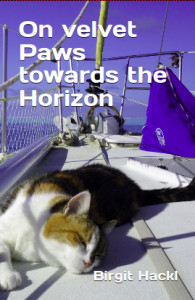
Pitufa’s a warm-weather boat: we have an open cockpit, no heater, so we hope for some mild autumn days soon. Tomorrow we’re planning to move to another island within the atoll, mostly to find an anchorage with better protection from the wind. Leeloo hates wind and hasn’t been out on deck for days. She’s getting grumpy and bored, she’s also no longer used to temperatures around 20 degrees and is working hard to quickly grow (even) thicker fur
2013
05
Jun
Winterly Gambier
2013
02
Jun
Polynesian Hospitality
We heard and read about the Polynesian hospitality before we came to the Gambier Islands and were curious, whether people would still be friendly and generous to strangers, or whether they were already fed up with too many tourists taking advantage of them.
We were positively surprised how alive the Polynesian hospitality still is. Everybody passing on the street greets with a friendly smile, people wave out of cars and when we went hiking last week we had an especially nice encounter: a woman actually came running after us, invited us to her terrace, got out a table and chairs for us, cut up fruit, introduced us to all her children and insisted on packing bananas and grapefruits in bags for us to carry back home. Isn’t that amazing? Imagine what a nice the place the world could be, if more people acted like that…
Today a young man invited us into his garden, offered us papayas and a whole banana plant for free and before we could stop him he uprooted two trees(!) to give the roots (manioc) to us–all with a smile and without accepting any payment. In the beginning we didn’t know how to deal with such generosity, but now we try to always have small presents with us to hand out, so that we don’t feel bad about taking advantage of people
Maybe we were lucky in our choice of island, because the Gambier still have very few visitors (especially compared to crowded places like Tahiti and Bora Bora). Tourism here is limited to the few cruisers on the sailboats and occasional visitors arriving on the weekly plane.
2013
28
May
Our first impressions of French Polynesia
Mangareva is the main island of the Gambier archipelago in the south-east of French Polynesia. Due to their location at the southern fringe of the tropics they have a mixture of tropical and temperate vegetation. The outer reef encloses these handful of islands and protects them from the ocean swell. The lagoon is calm as a lake — an incredible oasis in the middle of the vastness of the Pacific Ocean.
Here are some of our first impressions of Mangareva:
Iles Gambier: Mangareva
We arrived in the Gambier Islands, French Polynesia, towards the end of May 2013 and were enchanted by the lush island of Mangareva and its pretty town Rikitea.
(28 photos)
2013
27
May
Socks-and-soup weather
At the moment a low is passing by south of the Gambier islands sending freezing cold air up here. We’re shivering in temperatures in their low 20s–we’re just no longer used to temperate climates and have dragged the long trousers and hooded sweaters out of their hiding places in the back of the cupboard. Here it’s autumn and we just hope that the winter won’t be coming anytime soon.
2013
24
May
Pretty Mangareva
During the last week we’ve been trying to catch up with boat projects that have piled up over the past few weeks. We’ve been busy cleaning the waterline (incredible how much grows on a passage and how hard it is to get off), sewing the zipper of the lazy bag, washing and storing sails after the passage, doing the laundry (fortunately there’s a friendly German ashore who’s lived here for 30 years and provides the cruisers with all kinds of services), cleaning off mould, scrubbing the deck, etc., etc. and these are just the most urgent jobs ![]()
Additionally we’ve also brought all kinds of materials from Panama to do bigger projects as soon as we find time to work in a quiet place: cloth to upholster the sofa, material for a new rainwater collection/sun awning on the aft deck, a new tap for the kitchen, new electric sockets and plugs, etc., but these jobs will have to wait a bit, because Mangareva (the main island of the Gambier where we’re anchored now) is too pretty to be ignored.
We’ve walked over the hills to the southern side through lush tropical vegetation on the coast and pine trees further up and found a few farmers willing to sell good quality, but very pricy veggies. In general prices are very high here, as most things have to be shipped or flown in. On the other hand there’s so many fruit trees in all gardens that the locals call out to cruisers who walk by and offer them grapefruits, papayas and sometimes even bananas for free–the famous polynesian hospitality’s still a part of the culture here.
The next day we walked up to the Belvedere outlook providing a spectacular view over the turquoise bay that’s dotted with coral heads and bigger reefs, the smaller islands, the outer reef and the endless, darkblue Pacific Ocean beyond. Some of the boats who arrived in the same week as we did are already making plans for the next passage, but we’re just happy to be here and not thinking of moving on for quite a while
2013
24
May
Garmin GPSmap 4xx — How useful is a mini (4-inch) chartplotter?
On a small sailing yacht, power consumption is a real issue, particularly on passages. A wind generator is typically useless on a downwind course and often the sails shade the solar panels and there might be days with a thick cloud cover. Some electrical devices can be assumed to be running 24 hours a day: the fridge, some instruments (e.g. log, wind, …), a VHF radio, and in our case also an AIS transceiver blackbox. (Cruisers who rely on an electric autopilot usually don’t worry that much about power consumption since they need to run a Diesel or gasoline generator regularly anyway.)
What about a chart plotter? First of all, why would we need a chartplotter 24 hours a day at all? In our case the answer is (a) to have an AIS viewer which issues AIS alarms, (b) to view speed and course over ground and (c) to view the great-circle route and the deviation from it. Of course there are small, dedicated devices on the market such as stand-alone AIS viewer or ordinary GPS devices which could do the required jobs, but we don’t have them.
Running a chartplotter with a nice and large display (e.g. 8 inch or even larger) all day long, most likely consumes too many amp-hours. E.g. our Simrad NSE8 (8-inch display) draws around 2 amps. Its larger sibling, the NSE12 (12-inch display) requires even 3 amps, i.e., it would eat almost 72Ah per day.
In addition to our NSE8 at the nav station inside we also have a mini chartplotter at the helm in the cockpit. It’s a Garmin GPSmap 421 with a 4-inch display. The nice thing is: it draws even less than 1 amp and we can run it continuously when underway.
We installed it on its swivel bracket such that we can view it from behind the wheel (typical chartplotter-aided navigation), when sitting in the cockpit in front of the wheel (our classical watch position on passages) and even when looking up the companion way from the saloon. I don’t think that a larger plotter could be mounted so versatilely. It is tiny, and indeed, we have seen dinghies with larger plotters (or fish finders), but for our overall setup the 4-inch Garmin–nickname Armin–is the ideal cockpit instrument.
2013
23
May
Photos of our long passage
Passage to Polynesia
In April 2013 we set sail from the Galapagos Islands towards the Gambier Islands in French Polynesia. 2900 nautical miles, 24 days at sea---our longest passage so far.
(27 photos)
2013
21
May
Pitufa in French Polynesia
Finally we are where we long dreamed to be. We’ll spend the rest of the year exploring the Isles Gambier, maybe some atolls of the Tuamotus, and the Marquesas.
2013
20
May
Rainbow island
The approach to the harbour of Rikitea on the main island of the Gambier archipelago was a bit more exciting than we’d have hoped for being exhausted after 24 days at sea. The wind gusted up to 30 knots when we approached the pass through the outer reef (the archipelago is surrounded by a huge diamond-shaped reef, 20 miles diameter). We had to motor right against the wind and Pitufa got soaked in salt water again. The main harbour of Rikitea is protected by another set of reefs. The French charts are excellent and green and red buoys mark the channel: a system that looks wonderfully simple on the chart, but like a chaotic maze when you get there. Christian was sitting downstairs with the Laptop shouting up commands and I took Pitufa in short legs (right, quickly left, right, right!!!…) through the maze into the calm, protected harbour. It’s a wide area with about 15 boats anchored: a typical cruisers bay with a strong sense of community. We hadn’t quite finished dropping th e anchor when the first dinghies approached welcoming us to the Gambier. New faces, faces to voices that we only knew from the SSB-radio net and old acquaintances. It seems on each boat something broke on the long passage(except on Pitufa
), so people are busy stitching sails, working on transmissions and helping out each other. We haven’t seen much of Rikitea itself yet, but we like what we’ve encountered so far: a prosperous community (about 1000 people, most live off black pearls), neat and tidy houses, lush gardens, fat dogs and friendly people (the only problem is to keep up with all the smiles and ‘bon jour!’s you have to reply to). The only downside of the prosperity is that people have stopped growing vegetables (too much effort?) and now everybody relies on the occasional supply boat… The climate is very pleasant with warm sunshine, relatively cool air (no wonder, we’re at 23 degrees south now and further away from the equator than ever during the last 1.5 years…) and regular, short rainshowers–most days we see several rainbows over the bay. Our French is still basic, but was enough to deal with the clearance at the gendarmerie, explaining the cat, etc. Leeloo had developed a ‘pimple’ on her cheek during the passage that refused to heal so we were eager to find a veterinarian and quite disappointed when told that there is none. We decided to ask around the anchorage and voila: the third boat we asked had a vet on board! He came over and declared the pimple a harmless cyst–we were quite relieved. Up till now we’ve been busy getting the boat back into shape, catching up with sleep and visiting other cruisers, but tomorrow we’ll start exploring. Many cruisers can stay only 3 months in French Polynesia, but as members of the EU we’re in a lucky position and can stay 18 months
2013
18
May
Arrived!
Arrived. Champagne & tapas. Sooo happy!
2013
17
May
Almost there!
Yesterday the wind got quite strong, in the evening we put the mainsail into the second reef–a wise measure: during the night we had up to 30 knots of wind. The Gambier Islands are just 50 nm away now and in order to arrive there in daylight we now have to deliberately slow down, which feels funny after crawling along for a week wishing for more speed. We still can’t quite believe that our first southsea atoll will appear on the horizon soon. Visiting such remote islands in the South Pacific was the reason why we set out. Until now we always felt like we were only passing by on the way, but now we get to the destination of our dreams.
2013
16
May
Day 22 and 222 miles to go
We’ve been at sea for 22 days, still have 222 miles to go and expect to arrive in 2 days. We have strong winds now, Pitufa’s rushing fast towards her first South-Sea atoll. We can’t wait to finally get to the Gambier Islands! We’ve started with our ‘French in 30 days’ textbook, Christian’s reached the 3rd lesson, I’m warming up my highschool French and have already got to lesson 8 out of 30
We’ll have plenty of opportunity to practice our French soon…
++++++
Wir sind jetzt seit 22 Tagen auf See, es bleiben noch 200 Meilen und wir gehen davon aus, dass wir in 2 Tagen ankommen. Wir haben jetzt starken Wind, Pitufa rauscht auf ihr erstes Suedseeatoll zu. Wir koennen es schon nicht mehr erwarten, eeendlich auf den Gambier Inseln anzukommen. Wir haben mit unserem ‘Franzoesisch in 30 Tagen’ Lehrbuch angefangen. Christian ist bei Lektion 3, ich waerme mein HAK-Franzoesisch auf und bin schon bei Lektion 8 von 30
. Bald haben wir jede Menge Gelegenheit Franzoesisch zu ueben…
2013
15
May
Rushing downwind!
The whole last week a weak, slow moving front (according to the NOAA forecast) followed us, resulting in fickle winds from different directions and complete calms in between. In the beginning we were glad to get some rest, be able to clean the boat, bake bread, etc., but after a while we got extremely impatient. Being becalmed means either crawling along with flapping, banging sails (neither good for the boat, nor the nerves), motorsail (noisy, fuel consumption) or take down the sails and roll violently in the ocean swell. We tried all three options and liked none of them… Last night we finally got some steady wind again and were able to crawl along under sails with 2 to 3 knots. This morning the wind picked up, we poled out the twin foresails and now Pitufa’s doing what she’s best at: rushing down the waves, lifting gently up and down with the waves swoooshing along her keel, singing Wagners Ride of the Valkyries
Our mood has lifted with the wind, but we can’t wait to get to the Gambier Islands. We’re slowly running out of veggies and fruits and are now down to long lasting produce: apples (just 1 left), carrots (2 left), cabbage, onions, potatoes and a pumpkin. Like so often I have the feeling that cruising doesn’t only mean travelling over distances, but also in time. Life on a passage or in a remote anchorage gives us an idea how people lived before everything became available in supermarkets at all times of the year. Only 300 miles to go!+++++++++ Die ganze letzte Woche verfolgte uns eine schwache, sich langsame bewegende Front (laut NOAA Wetterbericht) und bescherte uns unzuverlaessigen Wind aus wechselnden Richtungen und Flauten dazwischen. Anfangs waren wir noch froh, ein wenig ausrasten zu koennen, Zeit das Boot aufzuraeumen, Brot zu backen, etc., aber nach einer Weile wurden wir extrem ungeduldig. Bei Flaute auf einem Ozean kann man entweder mit flappenden, schlagenden Segeln dahinkriechen (schlecht fuers Material und die Nerven), motorsegeln (laut, heiss, Dieselverbrauch) oder die Segel herunter nehmen und wild in der Duenung rollen. Wir haben alle drei Moeglichkeiten ausprobiert und mochten keine davon… Letzte Nacht setzte endlich wieder stetiger Wind ein und konnten unter Segeln mit 2 bis 3 Knoten dahingleiten. Heute Morgen hat der Wind aufgefrischt, wir haben die Zwillingsvorsegel ausgebaumt und jetzt macht Pitufa das, was sie am besten kann: sie stuermt die Wellen hinunter, hebt sich sanft, wenn die Wellen mit einem lauten WUUSCH unter ihr durchstroemen und singt dabei insgeheim Wagners Ritt der Walkueren
Unsere Stimmung hat sich mit dem Wind gebessert, aber wir koennen’s gar nicht mehr erwarten, zu den Gambier Inseln zu kommen. Unsere Frischgemuese und -fruechte gehen langsam zu Ende und wir haben nur noch lang haltbare Sachen: Aepfel (1 uebrig), Karotten (2), Kraut, Zwiebel, Kartoffeln und 1 Kuerbis. Wie schon so oft habe ich das Gefuehl, dass Cruising nicht nur Reisen ueber Distanzen, sondern auch durch die Zeit bedeutet: das Leben auf See, oder in einer abgelegenen Ankerbucht gibt uns eine Idee, wie die Leute lebten, bevor alles zu jeder Jahreszeit in Supermaerkten erhaeltlich war. Nur noch 300 Meilen vor uns!
2013
14
May
350 miles to go
For whatever technical reason we could’t post on our blog for a while, but the problem is solved again. Thanks Thomas! After almost a week with light and fickle winds, it seems, according to the forecast, we’ll have good sailing conditions for our remaining 350 miles to go.++++++ Wir konnten fuer eine Weile keine Berichte auf unseren Blog schicken — aus welchem technischen Grund auch immer — aber das Problem duerfte wieder behoben sein. Danke Thomas! Nach fast einer Woche mit leichten und unbestaendigen Winden bekommen wir, so sagt zumindest die Wettervorhersage, gute Segelbedingungen fuer unsere verbleibenden 350 Seemeilen.
2013
10
May
post-by-email
It seems our post-by-email feature stopped working. of course exactly then when we’re in the middle of the pacific ocean… all is well onboard.